
As Indian businesses continue investing in large-scale expansion projects across manufacturing, infrastructure, logistics, healthcare and industrial sectors, project execution is increasingly becoming a boardroom concern rather than only an operational responsibility.
According to Realization India, companies are now facing growing pressure to complete capital projects with greater predictability as delays begin impacting revenue timelines, market readiness and overall business performance.
Industry experts note that capital expenditure cycles are accelerating across sectors, with organisations committing significant investments into new plants, warehouses, facilities and operational expansions. However, alongside this growth, companies are also encountering rising execution complexity involving multiple contractors, suppliers, consultants and specialist agencies working simultaneously within the same project ecosystem.
Growing Complexity in Large Capital Projects
Execution specialists at Realization India say one of the biggest challenges in large projects is that every participating stakeholder operates with separate commercial priorities and operational pressures.
Equipment suppliers often manage deliveries across multiple projects at the same time, while contractors work to optimize billing cycles, workforce utilisation and cash flow across different sites. Although these are standard business realities, the coordination challenges emerge when project schedules depend on all stakeholders moving in sync.
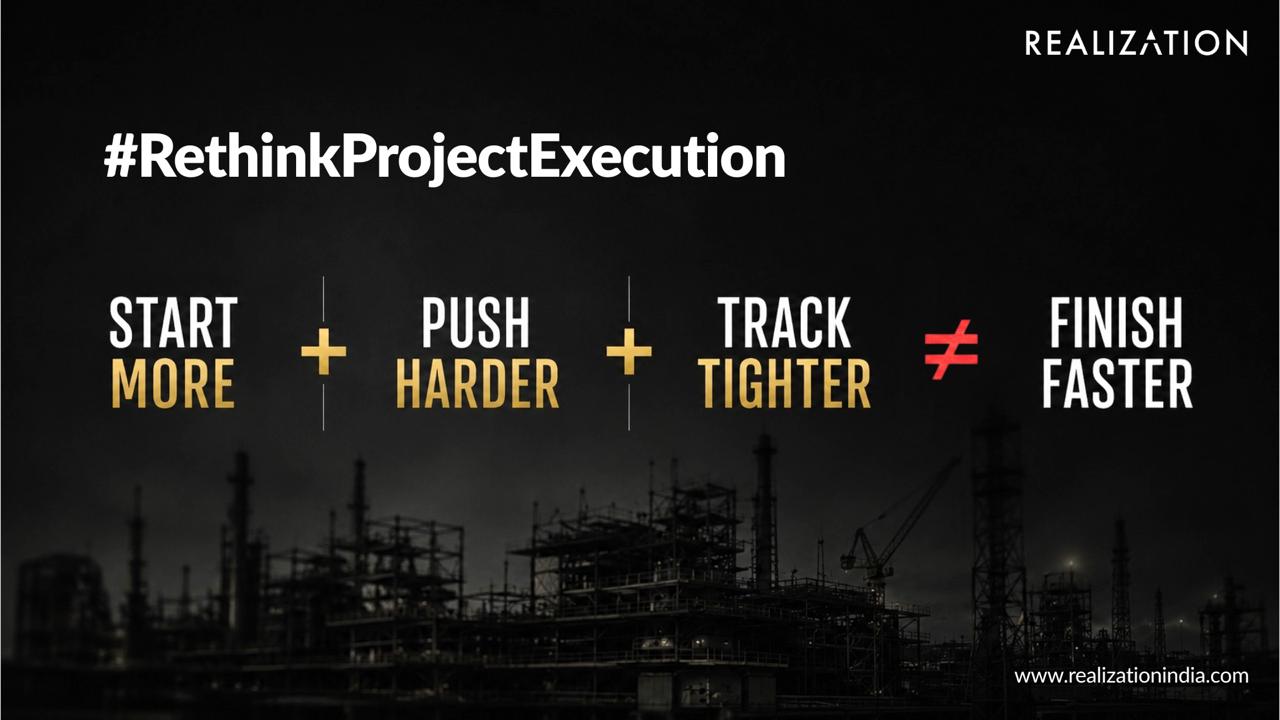
The company says many projects still operate through execution systems heavily driven by activity tracking and deadline monitoring. While these systems generate extensive reporting and visibility, they do not always ensure smooth project flow or timely completion.
As projects become more complex, organisations often respond by introducing additional review meetings, dashboards, revised schedules and tighter monitoring mechanisms. However, industry observers believe that excessive tracking alone cannot solve structural execution bottlenecks if dependencies and sequencing issues remain unresolved.
Shift Towards Completion-Driven Execution
According to Realization India, businesses are increasingly recognising the difference between visible activity and actual project progress.
In many projects, work begins simultaneously across multiple fronts, creating the appearance of momentum. However, incomplete handovers between contractors and fragmented execution frequently slow down subsequent stages of work. Civil structures may remain partially ready, utilities may not align with installation schedules, or approvals may delay connected activities despite visible progress on site.
The company says this often results in a growing volume of unfinished work, repeated coordination cycles and schedule revisions across agencies.
Industry analysts believe this has led businesses to gradually shift toward completion-oriented execution models where the focus is placed on stable handovers, dependency management and uninterrupted workflow between project stages.
Execution Reliability Becoming a Competitive Advantage
Another key challenge highlighted by execution experts is accountability fragmentation during delays. In complex projects, setbacks are rarely caused by a single issue. Delays in drawings, procurement, approvals or site readiness can create ripple effects across multiple work packages, making it difficult to isolate responsibility.
As a result, organisations may spend significant management bandwidth on reviews, escalations and revised commitments without necessarily improving execution reliability.
Executives at Realization India believe companies are now beginning to view project execution as a strategic business capability directly linked to profitability, scalability and operational readiness.
With industries expanding aggressively and competition increasing across sectors, predictable project delivery is emerging as an important differentiator for businesses aiming to improve speed-to-market and capital efficiency.
Industry observers say the conversation is gradually moving beyond traditional project management metrics toward broader questions around execution stability, coordination efficiency and business impact. As Indian enterprises continue investing in large-scale growth initiatives, execution reliability is expected to become a defining factor in long-term operational success.
